«November Golf Oscar» ship receives «Fuck you, NADIR. NADIR, fuck you, fuck you!» slurs via radio.
We start this operation by departing in the early morning at 03:45 a.m. from Lampedusa towards a distressed boat alerted about by Alarm Phone in the northern Maltese search and rescue (SAR) region. Halfway to the case, we see a speeding Italian Coast Guard vessel of the 300 French Admiral class passing us at full speed in the opposite direction. These boats are dedicated to offshore SAR operations, and it would later be confirmed that this boat evacuated the people we went looking for.
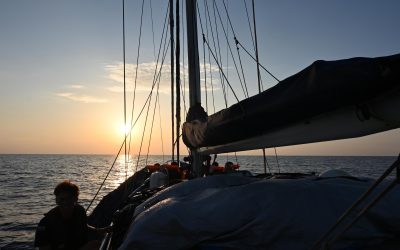
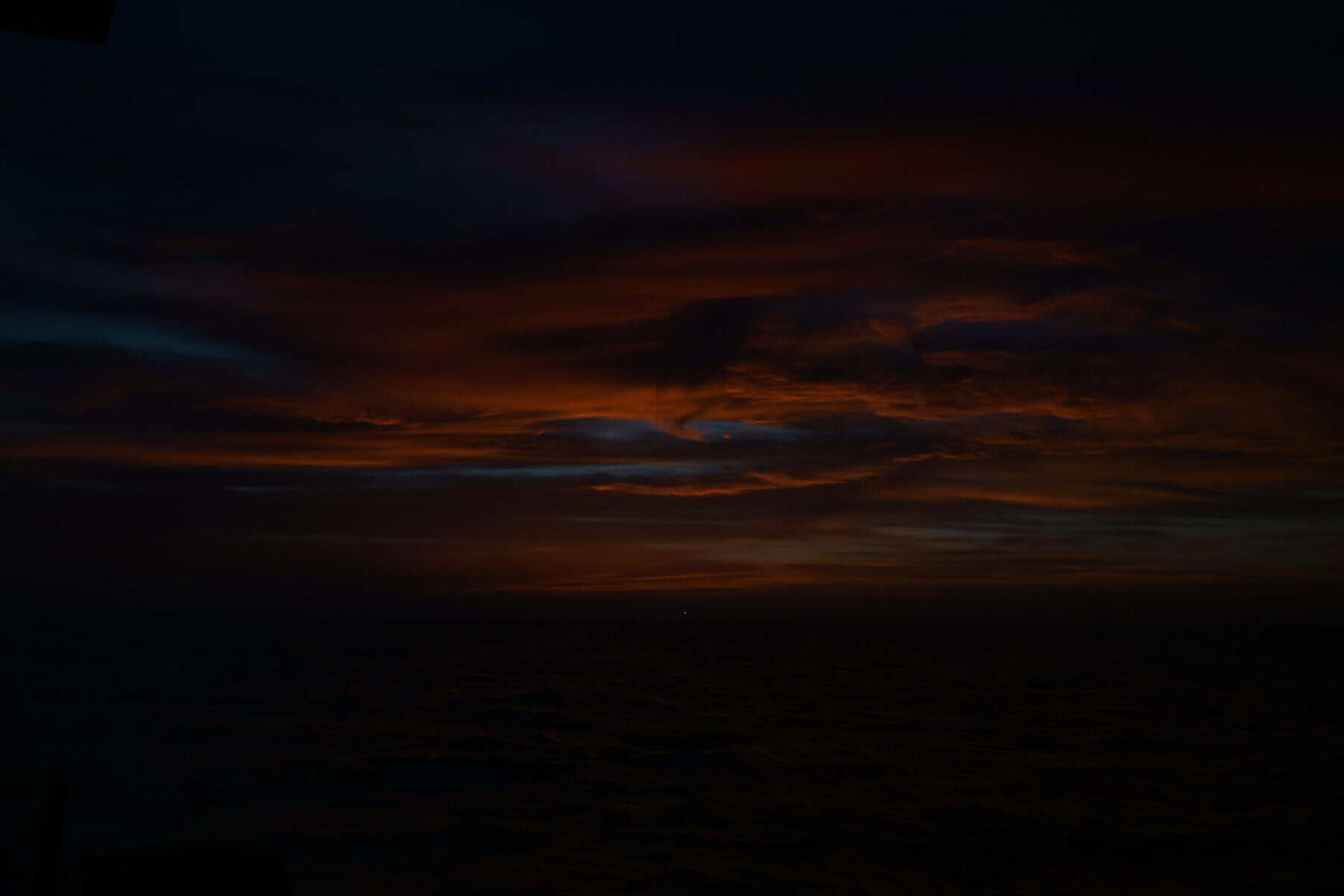
We move further south, to continue to patrol in international waters within the south-western Libyan SAR region until we have to head North in time to shelter from an incoming weather front. Early in the morning, as the first rays of light appear on the horizon, we have a brief encounter with the so-called Libyan Coast Guard (scLYCG) while moving north. Later we know, drawing conclusions from a steady reflection on the radar, that the Corrubia class vessel had already followed us for some hours before approaching closer from starboard stern – running dark1. Italy donated at least 14 Corrubia class patrol boats to Libyan forces in 2018 and 2023 as part of deals to reduce migration across the Mediterranean (Med). The radio is crackling. A polite voice asks via VHF¹ whether we have «migrants on board» and for coordinates of a «black rubber boat» – NEGATIVE. They retreat and depart, now visibly as the sun creeps up and paints a precise silhouette of the ship into the waves
On 11 May, looking out for people stranded in the Central Meds legal vacuum without adequate safety equipment, we are startled as we overhear a worrying communication on the VHF:
«Libyan Coast Guard, stop shooting. Libyan Coast Guard, stop shooting.»
demands a calm voice, followed by a broadcasted MAYDAY from the vessel Sea-Watch 5. The SAR ship patrols 60 nautical miles north of Tripoli, Libya – somewhere not too far East of us. This exchange won’t remain the only one we witness crouched in front of the VHF radio station. Over the day we listen to several concerning exchanges between the scLYCG and the SAR ship. Within the first hour, Sea-Watch 5 broadcasts two Maydays: One for being shot at and another one for (Libyan) militia threatening to board their ship. When eventually, about three hours after the Maydays are launched, a Frontex plane shows up and asks, if Sea-Watch needed support, everything seems calm until we hear Sea-Watch 5 yet again on the radio, requesting a Libyan militia asset on the VHF to stop harassing them for the third time. Being at distance but emotionally involved, NADIR’s crew is hyper alert for potential threats circling or observing us.
Stunningly, despite the little time between the imminent threats of violence and the offer of support, these allies – the European Border and Coast Guard Agency and the Libyan armed forces – did not appear to have any interest to engaging with one another to mitigate the situation. Just a week before these events, the German authorities had increased the security alert level for the so-called Libyan SAR region and thereby acknowledged the danger emanating in this region – usually inflicted by Libyan forces’ boats – official partners of the European Union (EU). However, Italian authorities did not initiate an investigation into those who threatened the NGO ship but launch a criminal investigation against the captain of the Sea-Watch 5 after the disturbed crew and survivors reached a safe port. The accusations: aiding and abetting illegal(-ised) entry.
Apart from the anxiety-inducing encounters with Libyan actors, the Med is very silent until we overhear an alert from the surveillance plane Eagle1 about a boat in distress around 30 miles north of Zawiyah making way northerly. Despite being rather far away we adapt course towards that area where not even 24 hours earlier a shooting at an NGO vessel took place. Hours later somewhere north of the alerted position, the Frontex plane Osprey1 starts looping around the reported position, then flying to us, starting to orbit for a while above us. As we call the aircraft about their intentions, they confirm to be searching for the boat in distress as well and soon take off. As the plane doesn’t report any sightings we abort our search heading westerly again – happily drawing away from again a Corrubia vessel that has been patrolling in our vicinity for hours. At this stage, we already feel, we’re under constant observation by several small and large vessels but usually with limited or no contact at all.
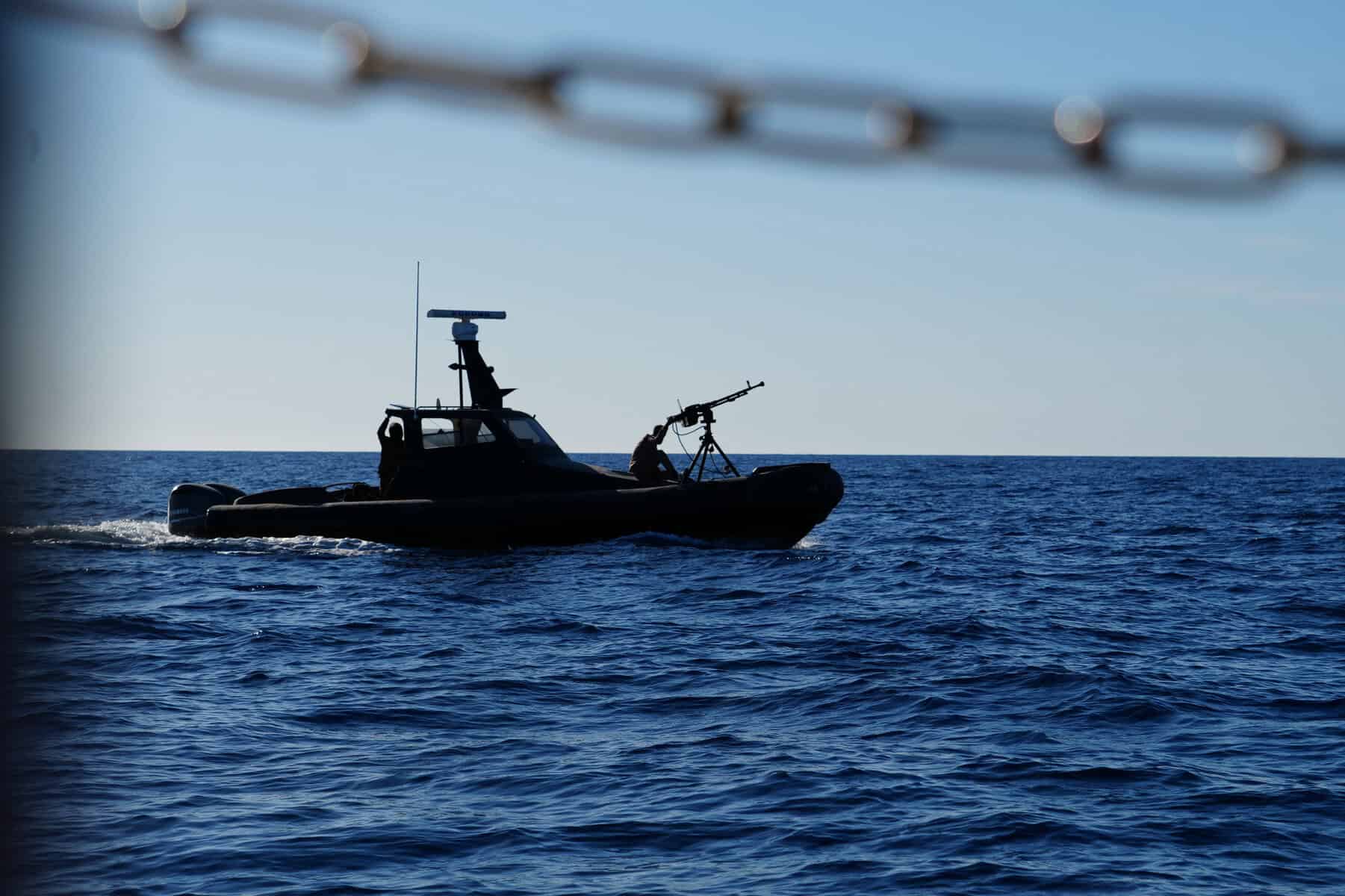
Little time passes when suddenly, yet another patrol vessel approaches us from stern, aggressively screaming into the radio. The black speed boat seems to be flying above the water as they come closer – repeatedly screaming into the radio:
«NADIR, NADIR, fuck you, fuck you!»
Only the frantic turns from left to right reveal their actual speed, the boat bouncing over the waves. The crew aboard the speedboat vessel keeps screaming at us on the VHF as it accompanies us for a while even though we repeatedly change course by 180 degrees.
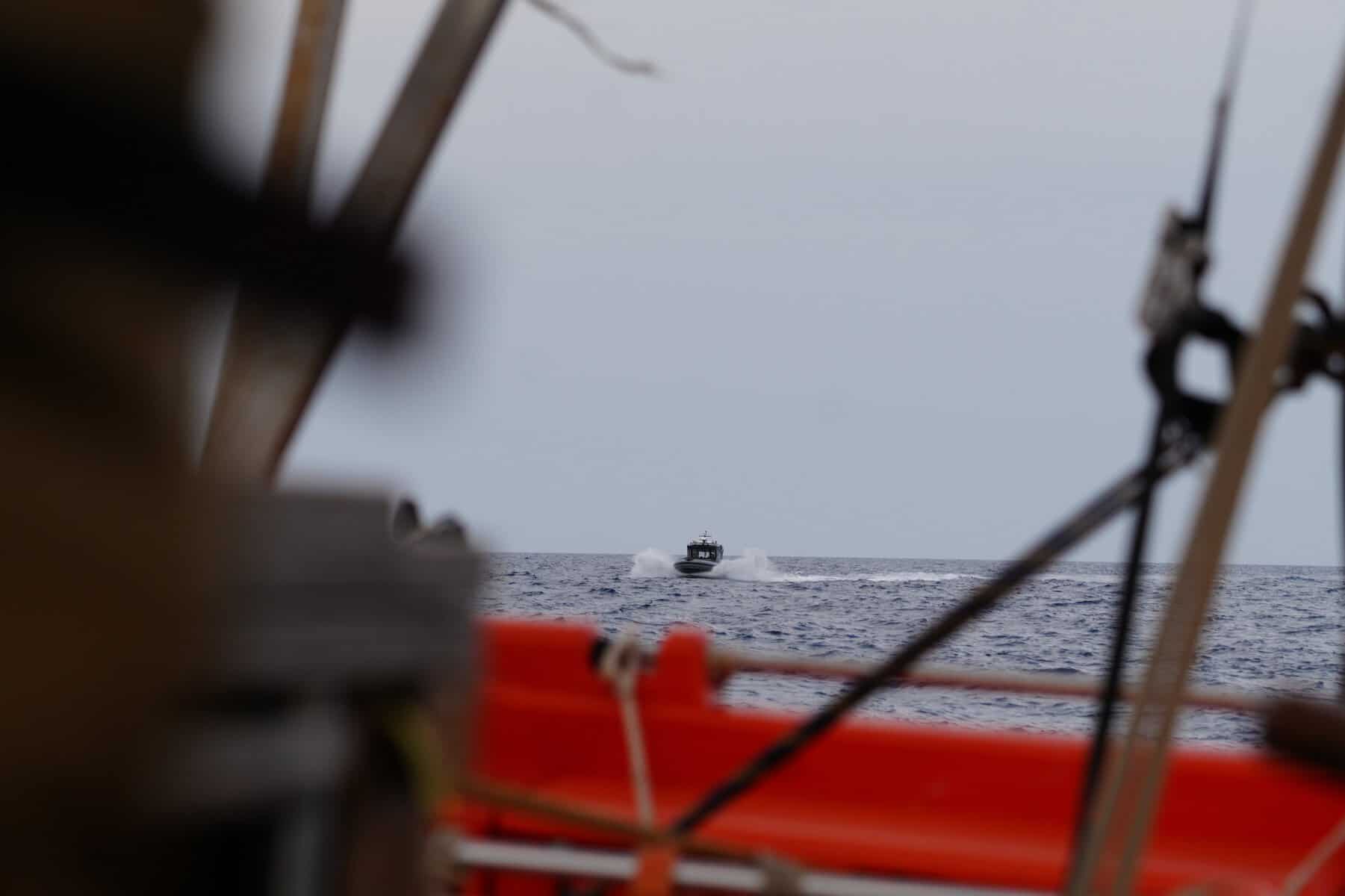
We know that in case we meet people in distress, we will lead the militia directly to them – causing an unsafe situation. For de-escalation purposes all NADIR crew recovers inside the ship and stays off the windows. Eventually, after hours, the speed boat seems bored and takes off.
Sometime later this day, in the darkness, we meet 44 people on a rubber boat in distress. The flames from an oil rig are reflected on the water. In this reflection, we can make out the small, black, elongated shadow with several tiny heads on top. It takes us an hour to distribute life jackets in a safely manner. We want people in safety, but we learned from our paramedic during the training that «slow is smooth, smooth is fast.»
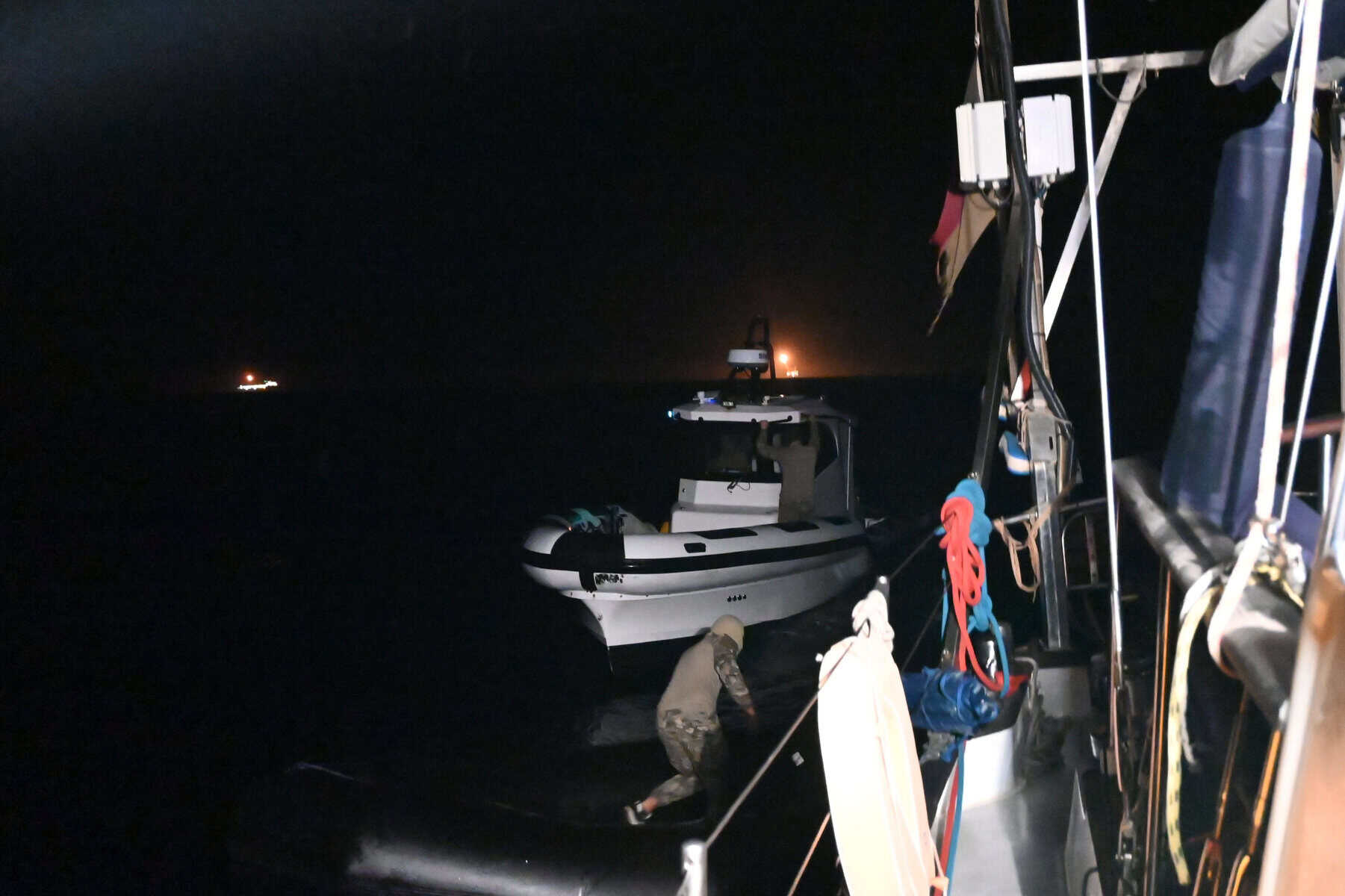
Starting to evacuate two persons onto NADIR’s tender, a Rafnar Professional 1200 speedboat comes to the scene and manages to position itself between NADIR, tender and the black rubber boat with the over 40 people in distress onboard. Silence cuts the air. Time stands still; I feel my heartbeat. From NADIR we can see, that three masked men on board carry machine guns – a finger on the trigger. The next few minutes pass in slow motion. They feel like hours.
One man from the patrol boat tries to grab the rubber boat at the bow but the boat slips away. He tries again and some passengers are getting visibility nervous. Via VHF, we try to convince the militia that we’re amidst a rescue operation and that interference is hindering safe operations – putting lives at risk. They men on the radio identify as Libyan coast guard. We notify them, that EU states are aware, that we’re amidst an evacuation. Eventually, they let go of the boat and withdraw. These minutes of helplessness could have ended different and we’re so relieved, swiftly taking the boat alongside NADIR.
The journey to our port of safety in Lampedusa is long. Underway we hear a lot of radio communication. Amongst other things, a Frontex operated Osprey plane seems to explain to the Tunisian Coast Guard what NADIR is doing. We cannot hear the Coast Guards’ questions but Osprey explains, that NADIR is outside of Tunisian jurisdiction underway to Lampedusa, bringing survivors to Italy and that Tunisia doesn’t need to be concerned about that. They explain, NADIR is an NGO vessel:
«Yes, ‘November Golf Oscar’2 boat.»
A couple of days later, we meet another boat in distress. The boat is a blue wooden double decker. In the early morning of 18 May we see a flickering light somewhere in the darkness at 5:30 a.m. but loose it again and carry on our course. 20 minutes later – the rising sun breaks through the darkness of the night, gently casting shadows on the water’s surface – we hear voices and whistling behind NADIR. There is the boat. Until all crew is awake and on deck, we’re close to them already communicating with each other.
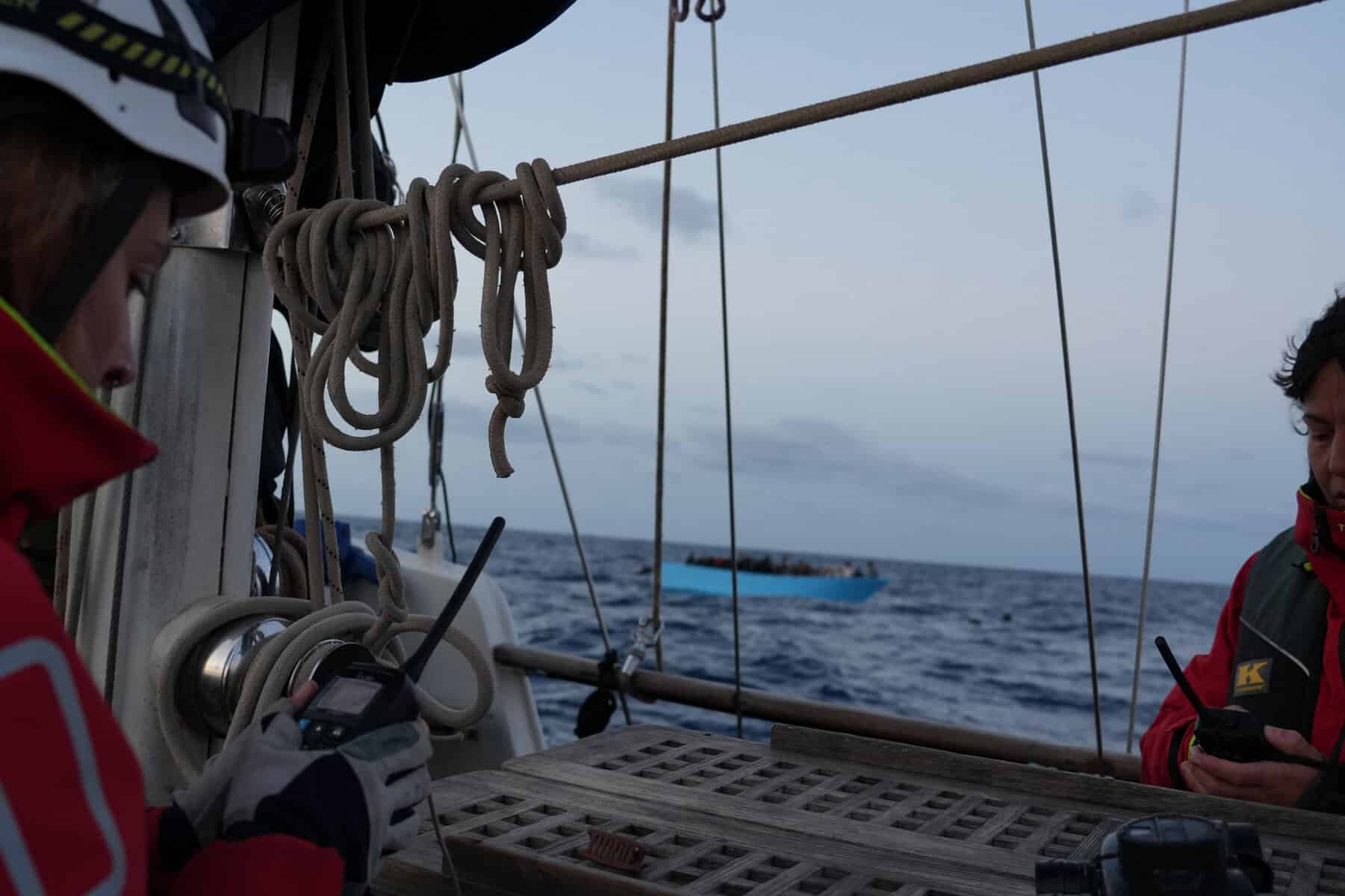
Everyone is more tired than usual, and waves rock the double decker from left to right to left to right, so we take a bit of time. «Slow is smooth, smooth is fast», I’m repeating inwardly, while anxiously processing the various possible scenarios with the double decker in my head. What if too cramped to distribute safely live vests? What, if there are people suffering below the deck? What, if there are medical emergencies – or worse?
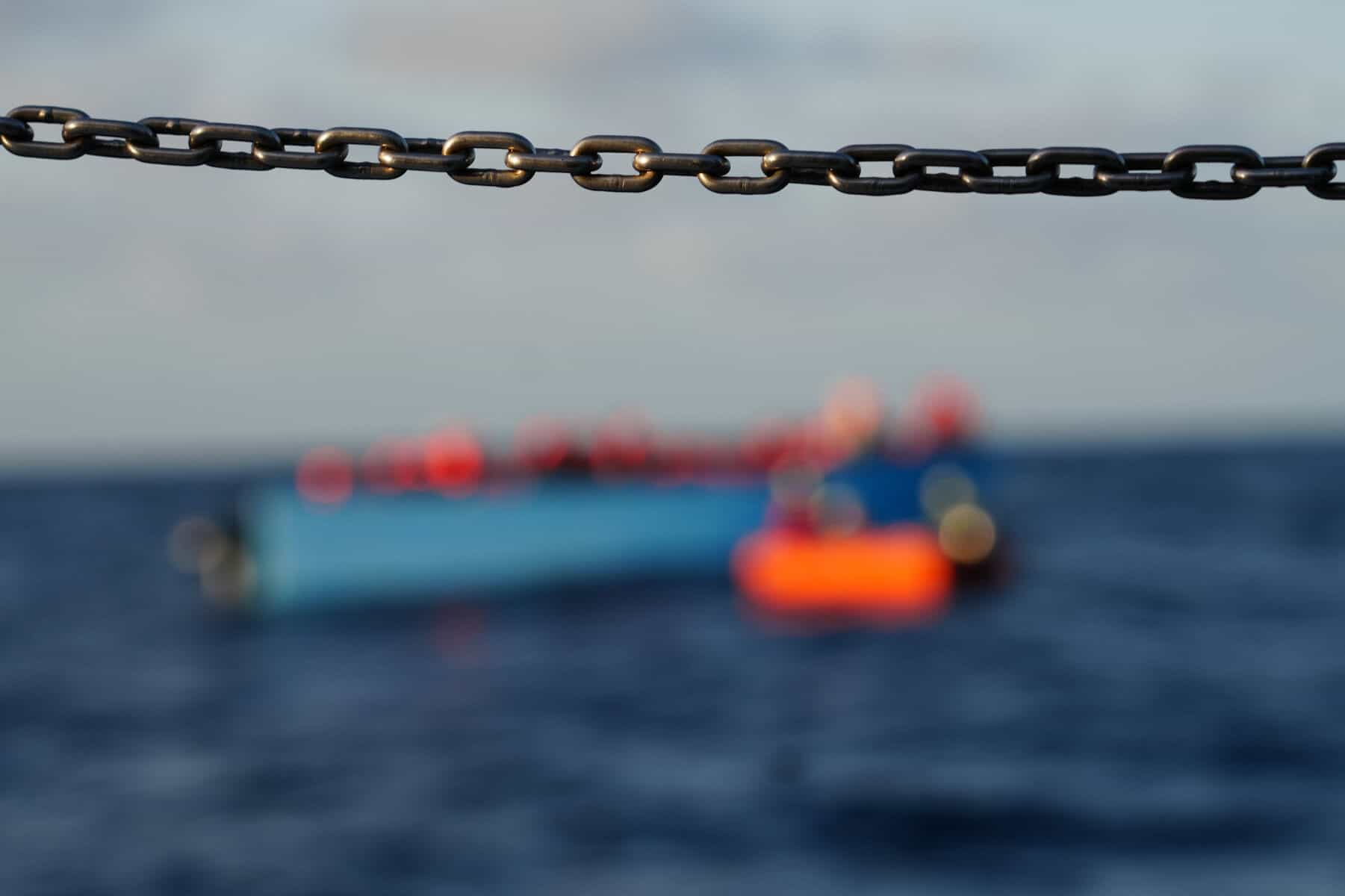
Soon, we’re relieved to hear from the tender crew that apparently there is nobody below the deck. We still prepare for all situations – nothing is clear and safe until we can confirm that every single person is off that death-trap. After 3.5 hours we can finally say: Everyone is well on board of NADIR.
With all 73 people are on board we learn that for a large part of the journey up to 50 people were travelling in the lower deck until water started coming in. Among them a four-year-old little human. People had been on sea for over 48 hours when we meet them. Apart from incoming water, the lower decks are also particularly dangerous because exhaust fumes accumulate there. Exposed to these toxic fumes for long can lead to death by suffocation. Several of the people we talk to had tried to cross the Mediterranean before, got intercepted and were forcefully abducted back to Libya. This time, their journey across the Med ends less traumatic with a disembarkation in Lampedusa shortly before midnight. We wish them farewell and good luck for the upcoming journey and all the hurdles that Fortress Europe has in store for them.
We have a day left to sail through the Med before our rotation comes to an end, reminiscing the density of violence we observed first hand in the last days. Although we have known about these attacks for years and have consistently denounced them and demanded accountability, they seem to be continuing, becoming normalised and, in some ways, even increasing. Our thoughts revolve around the absurdity of the situation and the scale of the violence during our encounters with the militia, who sometimes seem willing to cooperate with us and on other days seem prepared to use any means necessary to get rid of us.
How did we end up in a space, where the dying of hundreds of thousand human beings in the Med once filled newspapers, but where a decade of denied accountability yields to an unimaginable yet approval level of violence. Over 25.000 people² have confirmed dying but seeing the reality in the Central Mediterranean on a daily basis, we know these numbers are just a fraction of the reality. In a place, where hope dies and where humans do not just lose their loved ones forever, but are prosecuted if they survive.
Our rotation ends without meeting another boat in distress and we head towards our home port, ready for a restock and bunker for the next crew to patrol the Med to monitor, uncover and assist those, that have no lobby behind them and who are in urgent demand of support.
Considering the many shades of violence we face – from shootings targeting humanitarian actors, to people being thrown into the water, violently abducted, and forcibly returned to centres of detention where they are subjected to torture; from the prosecution of survivors and civil society organisations, to constant threats and political manoeuvring aimed at obstructing our efforts to provide aid; and from the weaponisation of legal and institutional frameworks to the ever-evolving mechanisms of repression – we must never forget:
The biggest problem is not the person holding the Kalashnikov, but those who enable the use of such weapons in these situations. And it is them we must hold to account: The European Union – Nobel peace prize lauderate 2012³ – and it’s policies, including the outsourcing of border control to third countries. The EU carries the responsibility to the violence and lawlessness at sea.
Operational Report 3 – 2026 (2 May – 23 May, 2026) written by crew member Jelka Kretzschmar
Credits: Lena Agnes Borden, Jelka Kretzschmar | RESQSHIP
Footnotes:
- Very High Frequency: The radio frequency band is widely used for FM radio broadcasting, television broadcasting, two-way land mobile radio systems, and marine and aviation communications. VHF Channel 16 is the international maritime distress, safety, and calling channel monitored by all ships at sea.
- https://missingmigrants.iom.int/region/mediterranean?region_incident=All&route=3861&month=All&incident_date%5Bmin%5D=&incident_date%5Bmax%5D=
- Nobel peace price received for over six decades of contributing to Peace, Reconciliation, and Democracy. https://www.nobelprize.org/prizes/peace/2012/summary/