Letters to land from approximately 34° 38.5 N, 13° 22.5 E
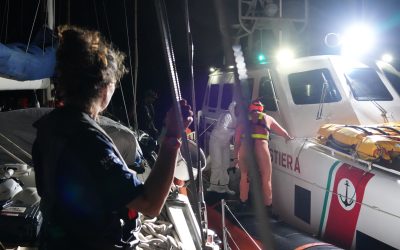
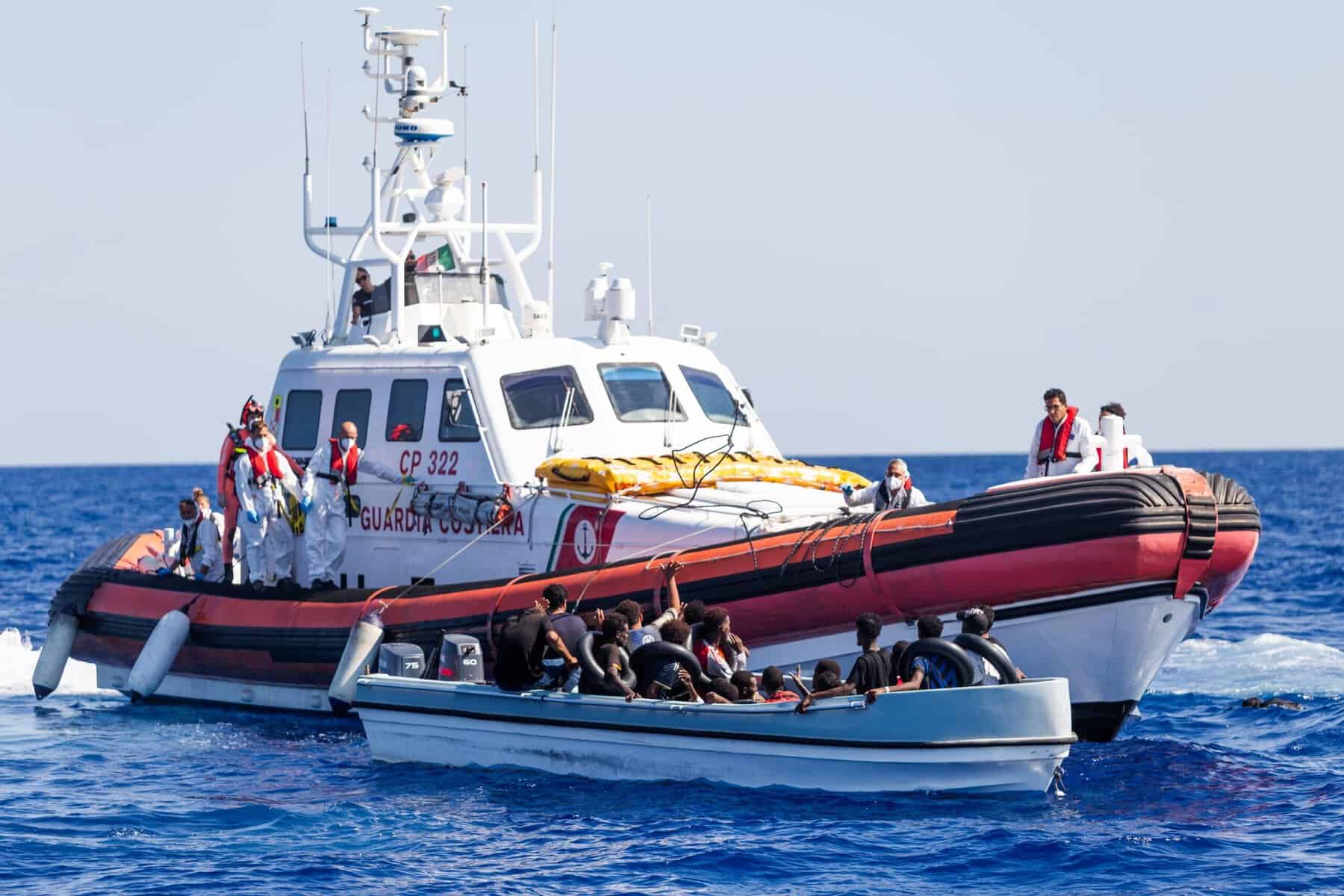
Today we located 15 people in distress on a fiberglass boat with two 20-horsepower engines. A white dot on the horizon that seemed very far away instantly turned into a boat with 15 survivors on board, all male. They were dehydrated and exhausted, but overall in stable condition. Along with us – probably alerted by the very plane whose track we were following – the Italian Coast Guard arrived. We were still in the Maltese search-and-rescue region (SRR), but the Maltese didn’t lift a finger. Nothing new.
The contact was brief – just enough time to reach them with the tender, determine their numbers, and advise them on safety measures while reassuring them that assistance was at hand. The Italian authorities promptly took over the situation. An Arabic-speaking mediator on board communicated with the survivors, and they quickly transferred everyone to proceed to Lampedusa.
We continued patrolling southeast. Watch The Med – Alarm Phone (AP) had alerted us to a case involving about fifteen people, including women and children. We were supposed to make contact with them between 9 p.m. and midnight. Unfortunately, after a certain point, no further updates could be provided. With the engine at full throttle, the crew stayed on watch until 1:30 a.m., scanning a 360-degree radius using the infrared mast camera and binoculars.
We were not successful. We never found them.
Now we’re drifting with the wind, the rudder locked and the engine off, having used up a lot of fuel to get here. Searching at night without clear coordinates is extremely difficult. It is challenging enough during the day, but once pitch blackness sets in, visibility is severely compromised – making the search both technically complex and physically exhausting.
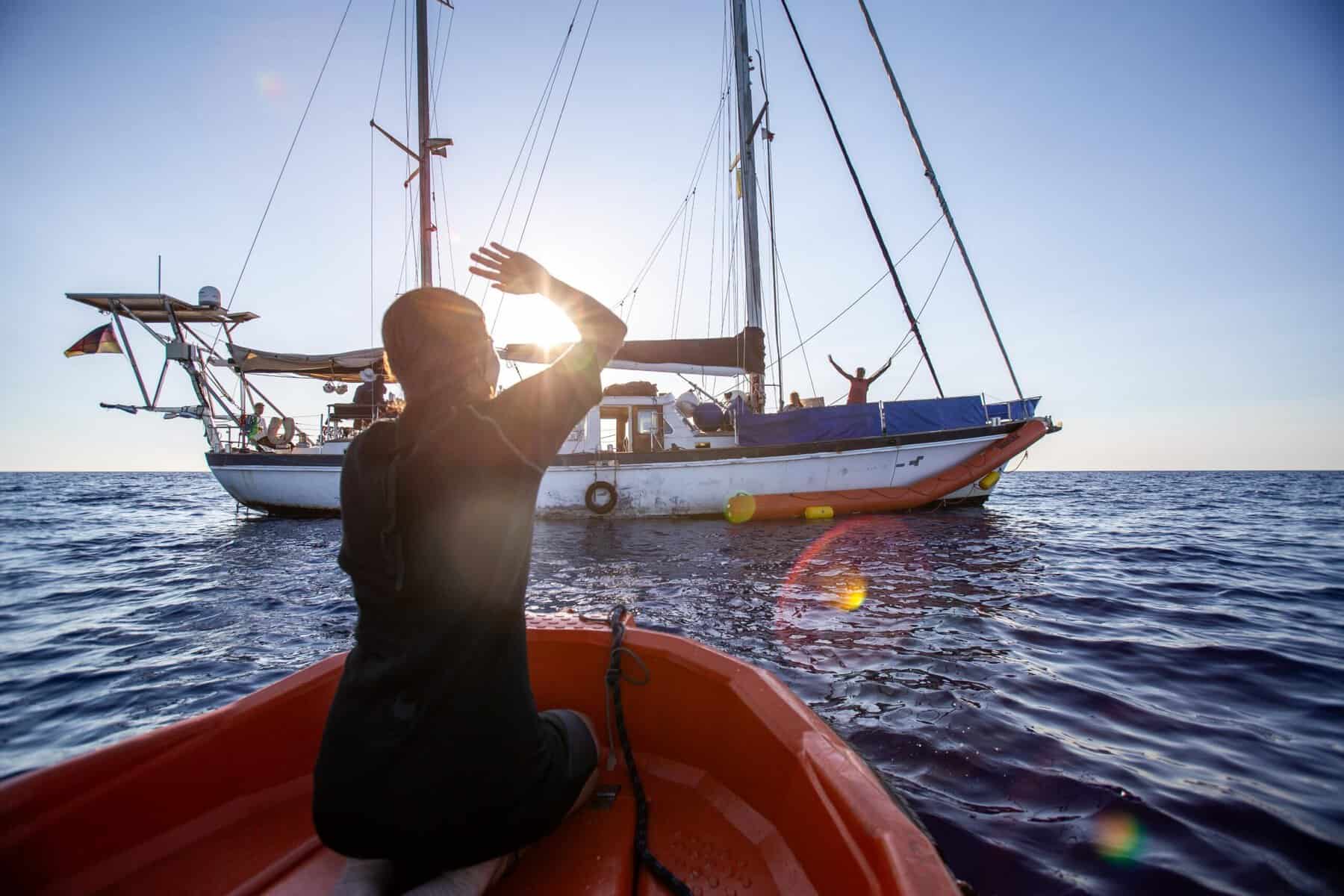
The training we went through over the past few days prepared us well. We continue to practice maneuvers and procedures should we encounter a situation with multiple variables and a higher level of severity.
Tomorrow we’ll likely head further south into the Libyan SRR. Every decision – whether to wait, continue, or conduct exercises – is a gamble, because we cannot predict where the next distress call will come from. We (almost) always decide together, as a crew. We have another 13 days at sea ahead of us; conditions can shift in an instant, and it takes very little to disrupt the group’s emotional balance.
My watch ended at 4 a.m., but I stayed on deck a little longer to gather my thoughts and feel a bit less alien in this vast, watery expanse with its distinct codes, language, and sheer scale.
The Milky Way traces a celestial arc above the NADIR. She drifts quietly, like a vessel in the midst of a dark void that has lost its immediate course, but not its mission.
A hug to you all from the darkest moment before dawn.
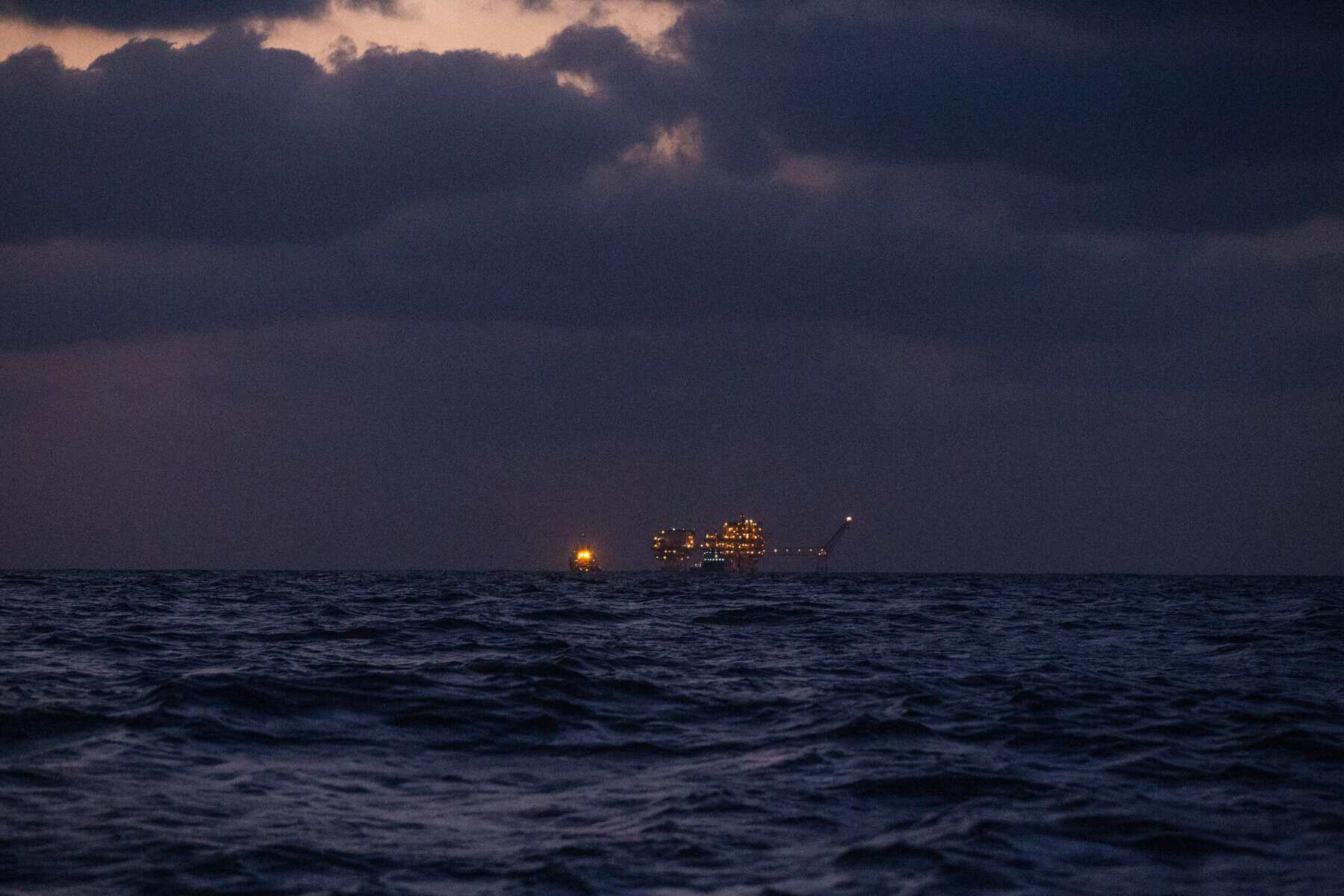
“Mayday Relay – Mayday Relay… 35530 5519 EAST 0123844 NORTH, this is XX… 30, 3–0 people in distress, a rubber boat, they’re moving at about 3 knots… all ships… I repeat […].” This is roughly how a distress call relayed by a third party begins, addressing all vessels in the area. It could originate from an Osprey, an Eagle 6, or a Seabird – whether Frontex or civilian reconnaissance aircraft – or from a fishing vessel, a coastal radio station, or an anonymous party. It can even be a false Mayday, for reasons that remain unclear. From that moment, a clear operational protocol kicks in: the crew immediately verifies the coordinates on the chartplotter, calculates the distance to the reported location, and checks for other friendly assets nearby.
The call is often answered by Circomare Lampedusa, the island’s Coast Guard station, requesting information and confirmation. If we are the nearest asset, the next operational steps are determined immediately: we estimate the time to intercept, calculating the NADIR’s maximum speed (about 8 knots), the impact of both wind and currents, and the remaining distance. We douse the sails and start the engine. Reaching the position can take several hours. The sea resembles a vast desert – a cliché, perhaps – but searching for a 10-meter boat across such an featureless expanse makes that sense of disorientation very real.
In the meantime, we receive an update regarding the initial case we were unable to locate:
“The boat was intercepted by the Italian Coast Guard and handed over to the Libyans, according to a relative,”
stated an email sent to the NADIR.
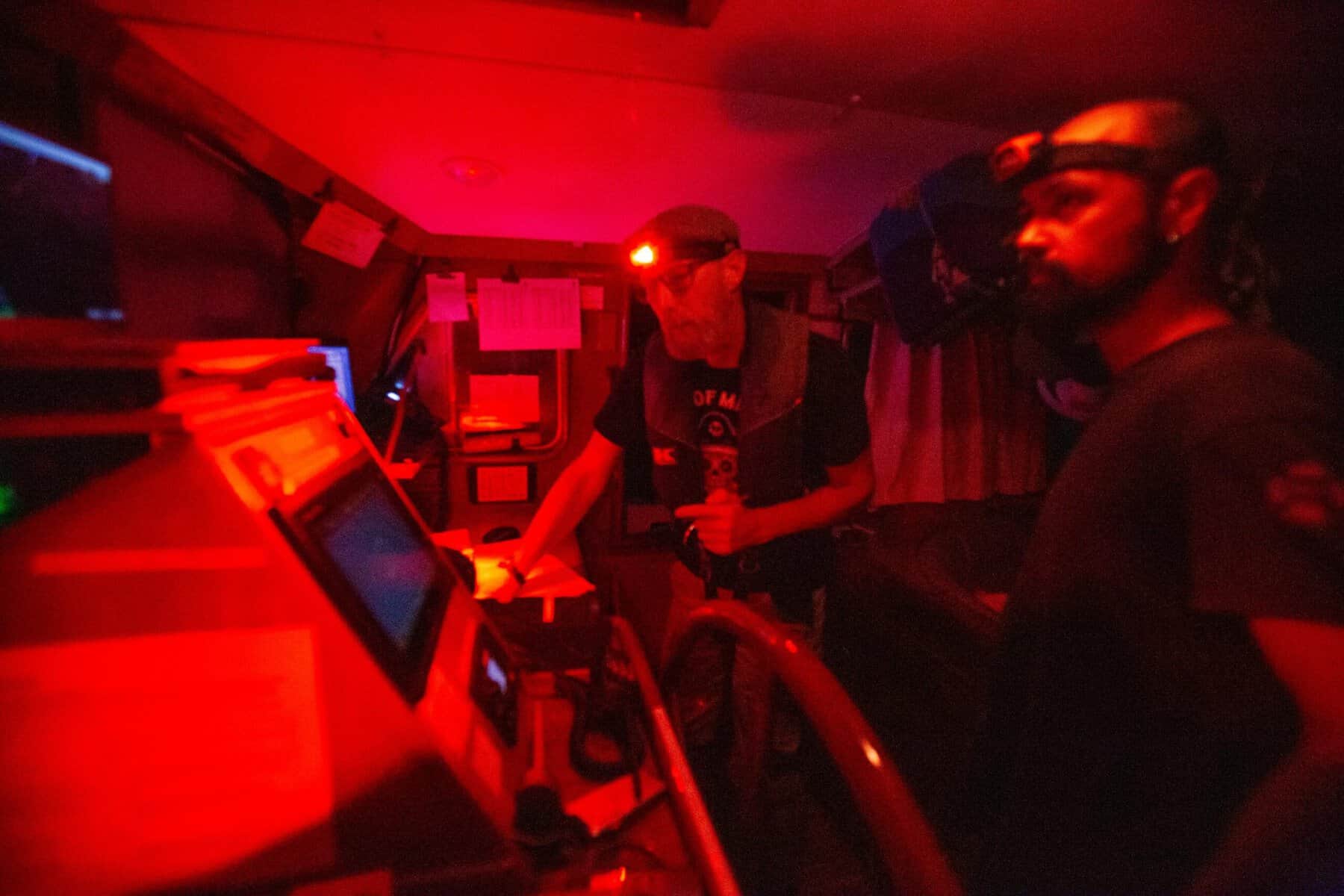
Now the wind has built to Beaufort force 4, a moderate breeze. The waves are growing to one to one-and-a-half meters, their crests breaking white like mountains after an autumn snowfall. The NADIR lurches and rolls, searching for its elusive balance. My body tries to adapt to the shifting motion beneath the deck. Seasickness is setting in among those unaccustomed to the sea. Meanwhile, for people on the move, these conditions mean far more than discomfort – they are life-threatening. Waves and spray cause the unseaworthy boats to take on water, drastically increasing the risk of both capsizing and hypothermia. After just a few hours of exposure to the elements, severe physical exhaustion sets in.
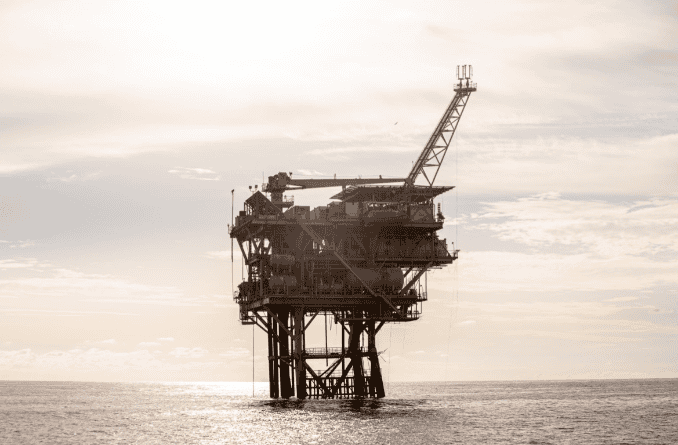
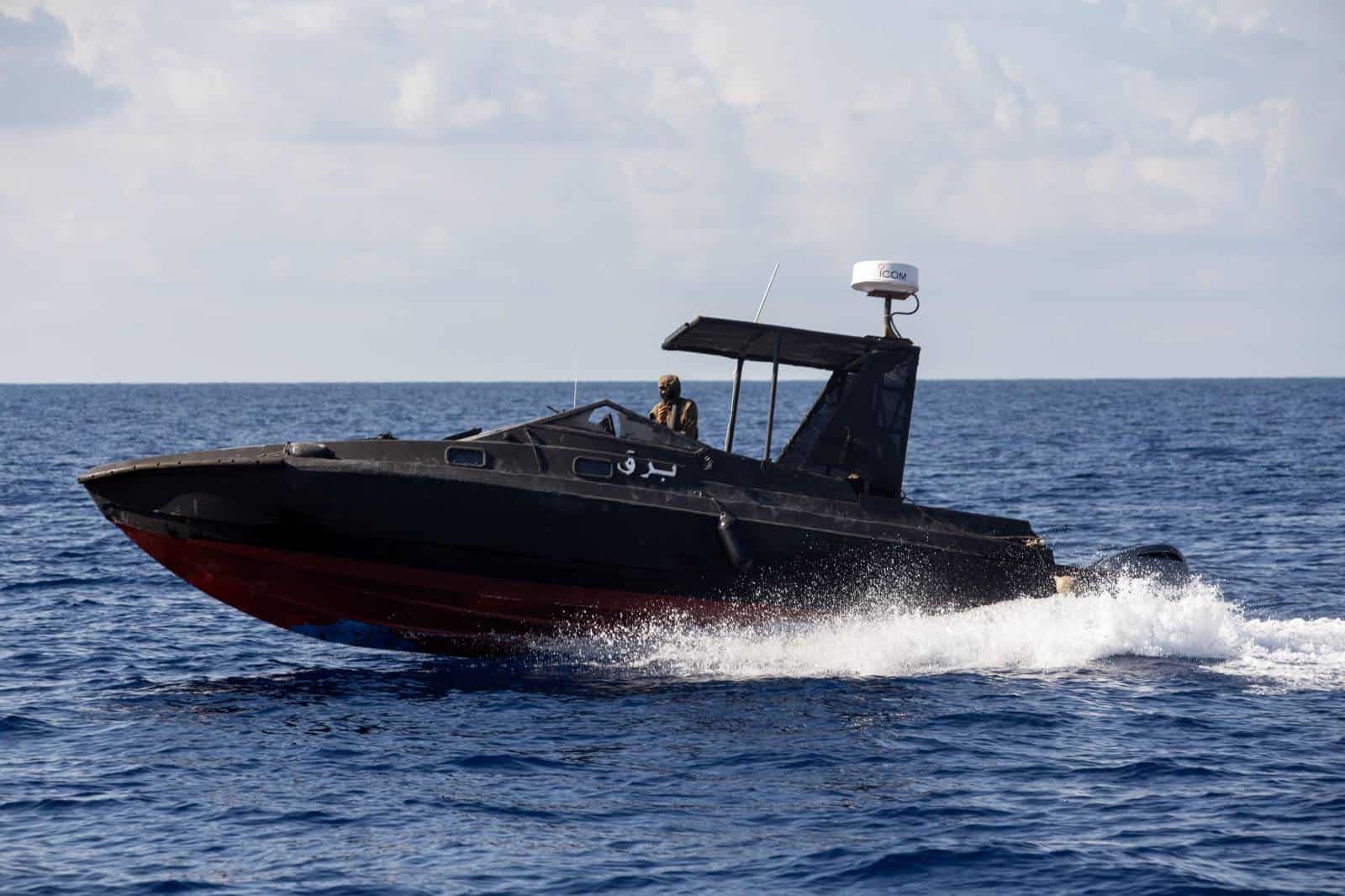
We are not far from the African coast. We respond to a Mayday Relay along the curve shaped route, which is taken by boats departing from Libya to reach the Tunisian SAR region as quickly as possible, allowing people to evade Libyan militia vessels – the first major hurdle on their journey. We remain vigilant as well. Over the past year, attacks on non-governmental organization (NGO) vessels by the so-called Libyan Coast Guard (scLCG) have escalated significantly: gunfire, intimidation, direct interference in rescue operations, and dangerous pursuits. Frequently, four or five of their patrol boats shadow us, maintaining a constant distance. People on the move sometimes try to reach two offshore oil platforms to exit the Libyan SRR. Yet as we have witnessed, even reaching them offers no protection from forced pullbacks.
Every fleeing boat marks a breaking point: it shatters enforced borders while laying bare the hypocrisy of a Western moral conscience stained with blood. Reaching a vessel in distress becomes a race against time between NGOs, Libyan militias, and the Italian Coast Guard – each acting on fundamentally conflicting mandates: human rights, bilateral agreements, or state sovereignty. The Mediterranean vividly exposes these structural frictions. A global system so committed to the free movement of goods and capital remains equally determined to erect insurmountable barriers against human beings. We are navigating one of the critical bottlenecks where these contradictions are fought out. The drive to survive knows no borders. People seeking safety dare to cross the Mediterranean, one of the deadliest border zones in the world.
“The swamp knows everything about death and does not necessarily consider it a tragedy: certainly not a sin.”
The first visible landmark when approaching Lampedusa from the south is its northwestern promontory, a high cliff rising majestically from the water. But the NADIR is still far off – 47 nautical miles (about 90 kilometers) from the island, traveling at roughly 5 knots (around 10 km/h).
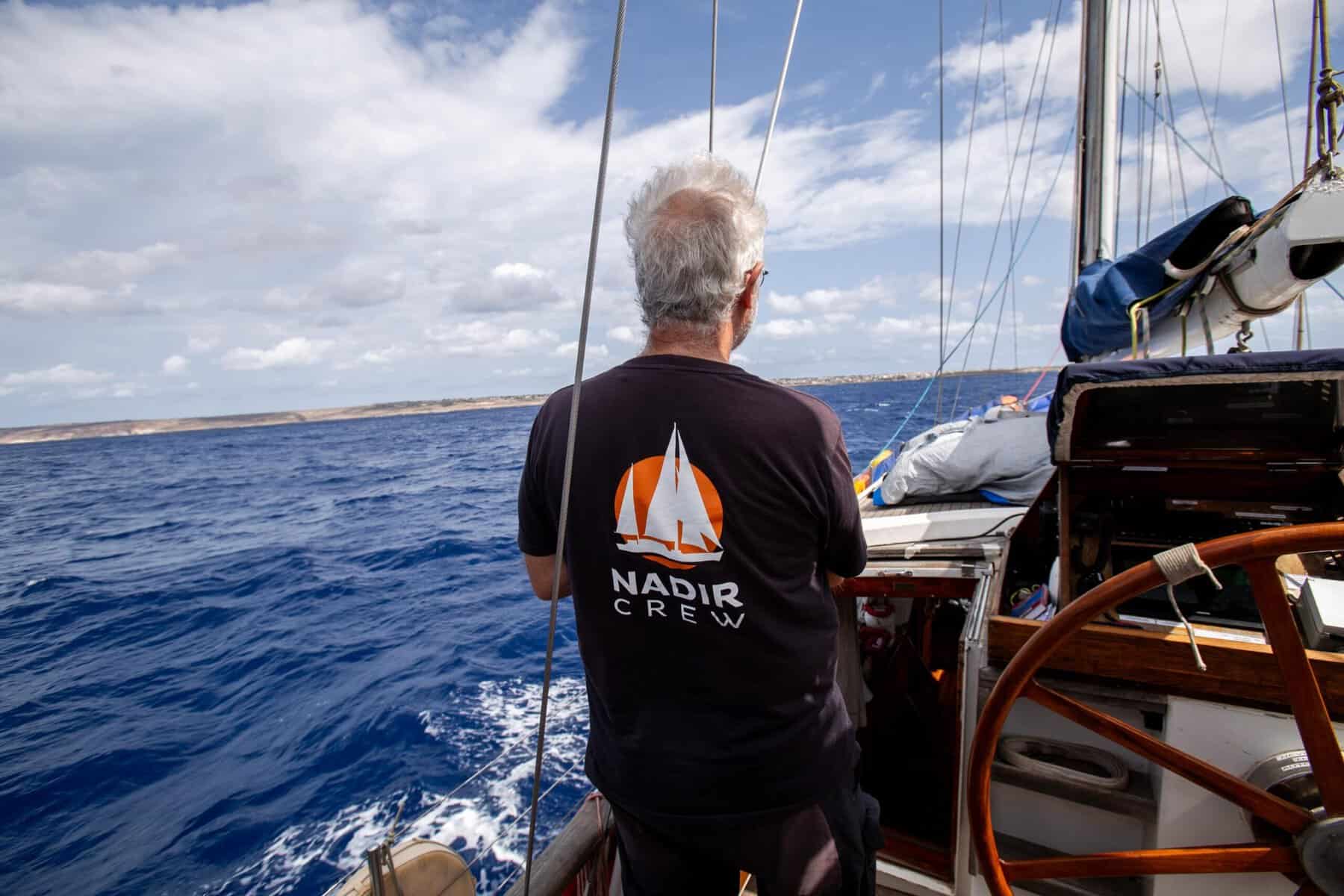
It is the midnight watch. Crew members from the previous shift wake us after barely two hours of sleep. Going to bed at 8 p.m., you are tired, yet the vessel’s motion, the dull hum of the cabin fan, the oppressive humidity, and the heat make rest difficult – compounded by the emotional weight of the day. You try to open the cabin hatch to let in fresh air, but it won’t budge. Then you remember: people are resting directly above on the bow deck. They are using the blankets and mats we set up for their initial care, making the passage on the fiberglass deck as manageable as possible. They are wearing clothing that feels unexpected to us after long hours under the September sun: heavy winter jackets, woolen hats, and long jeans – gear chosen to endure cold nights at sea. They spent the preceding 24 hours hiding inside the abandoned Didon oil platform in the Gulf of Gabès, within the Tunisian SRR. A sprawling industrial structure from another era – a maze of towers, pipes, and welded steel plates. Rust.
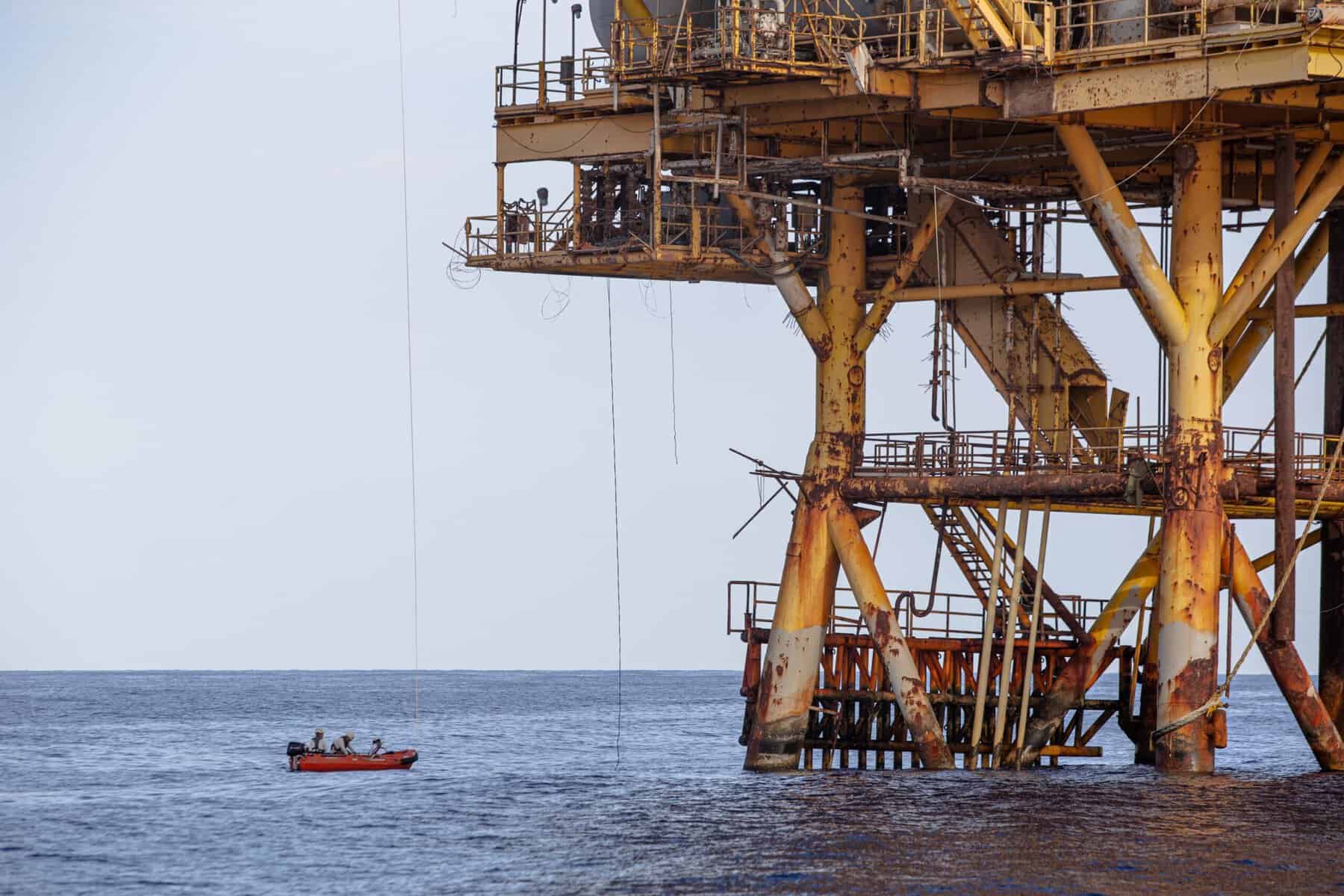
This mechanical wreck is entirely unfit for human life.
There was no boat moored alongside or drifting nearby. Yet, scanning with binoculars, we spotted a figure waving from the upper level of the platform. “We are friends, this is the rescue vessel NADIR,” the captain’s voice boomed through the loudspeaker. The figure waved frantically in response – there was life within that steel frame. The tender was launched immediately. Almost simultaneously, a so-called Libyan Coast Guard vessel approached, having shadowed the NADIR since midnight like a bird of prey.
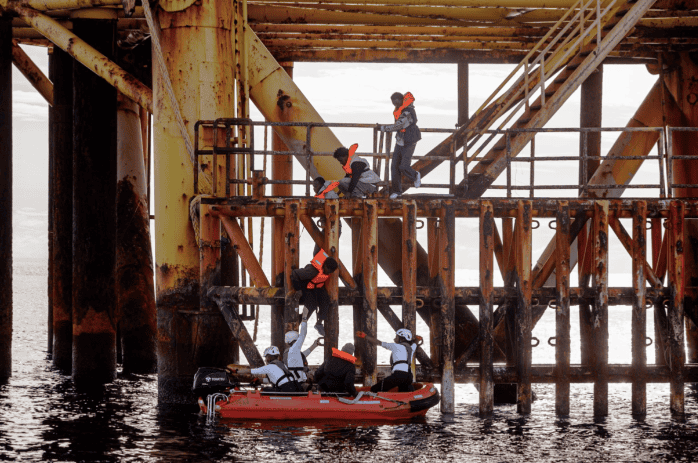
Using our RHIB, we managed to safely embark all five survivors, preventing them from being forced back by the scLCG. In scenarios like this, variables abound, but our commitment to bringing people to safety remains absolute. To stay ahead of interception, the NADIR sometimes approaches distressed vessels directly rather than deploying a tender – risking hull damage to provide an immediate safe haven. Without further interference, the Libyan patrol boat remained at a distance, accepting that it had arrived too late. The Didon is an abandoned Tunisian platform in international waters, situated in a jurisdictional grey zone between the Libyan and Tunisian SRRs. Prior to the operation, we informed both the Tunisian authorities and neighbouring SRR coordination centres via email – a necessary step to maintain legal compliance and prevent potential detentions in Italian ports. The Tunisian authorities stalled, stating without urgency that they would handle the investigation.
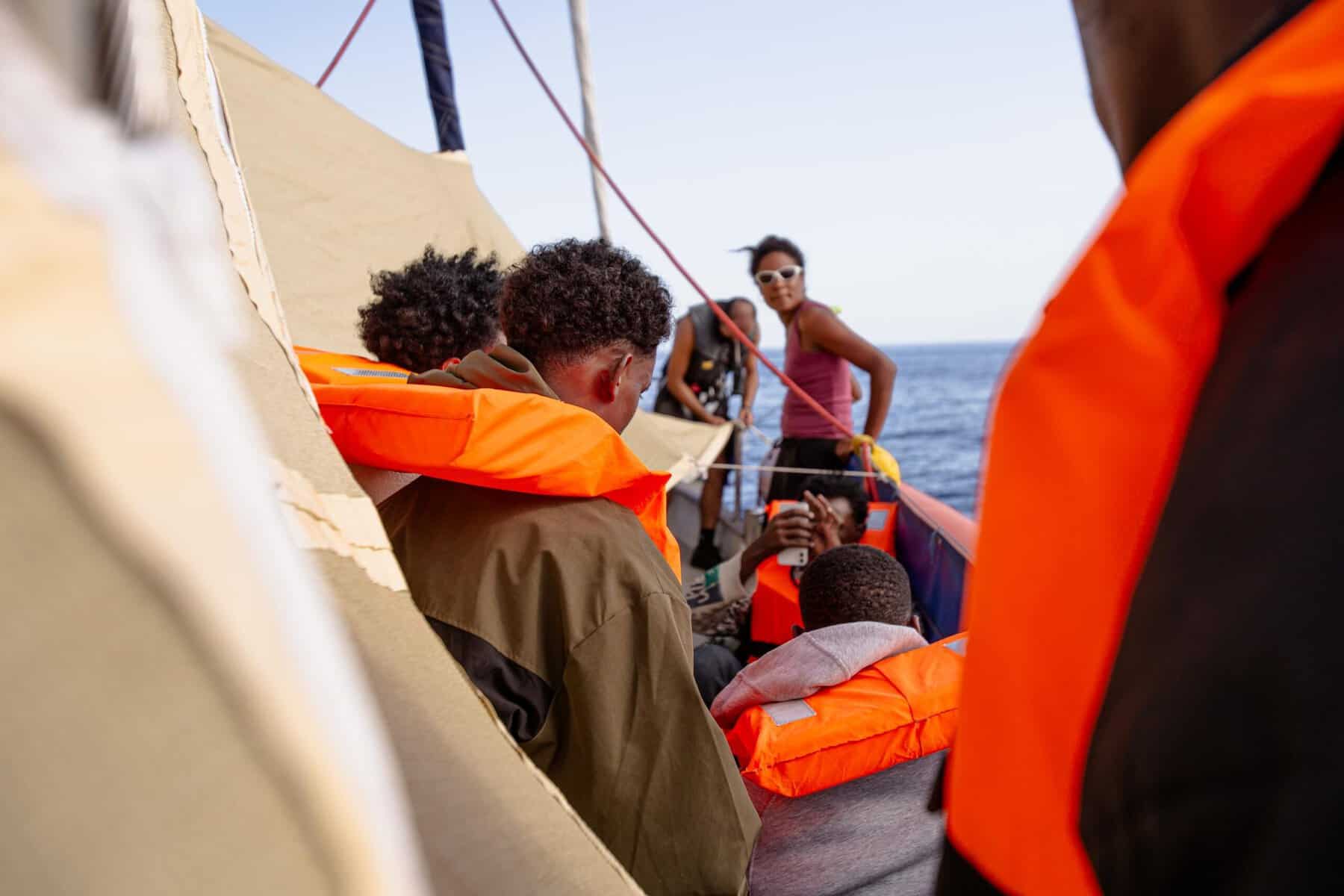
With five survivors on deck, the NADIR resumed its course northward. Seeing the immediate sense of relief on their faces brought a moment of shared quiet after days of false alarms.
Yet that moment was cut short by another broadcast: “Mayday Relay, Mayday Relay. This is Falcon 01 […]”. A grey rubber boat in distress with 30 people on board, deep within the Libyan SRR and far east of our route. The Ocean Viking was closer to the coordinates but unable to respond. Thirty nautical miles – three to four hours away. An eternity in waters so empty yet so densely monitored. As the call went out on Channel 16, time was critical. Distance expands on an 18-meter sailboat, whereas high-speed patrol boats can close gaps quickly. We had already been assigned Lampedusa as a Place of Safety (POS) for the five survivors on board. Under the Piantedosi Decree, we are legally required to proceed directly to the designated POS to avoid detention. Nevertheless, we requested clearance from the Italian MRCC in Rome to respond to the Mayday. They confirmed, and we altered course eastward.
We entered the search area indicated by the Frontex aircraft Falcon 01, stepping into that familiar tension between hope and apprehension. Scanning the horizon through binoculars, every glint on the water looks like a signal, though it rarely is. Every wave crest resembles a hull; every piece of floating debris becomes a track leading nowhere. The NADIR initiated a systematic search pattern to patrol the sector. Just before sunset, under a pale sky, the silhouetted platforms looked like cathedrals from a distant future. Fishing vessels crossed the horizon like quiet passersby in a vast, still landscape.
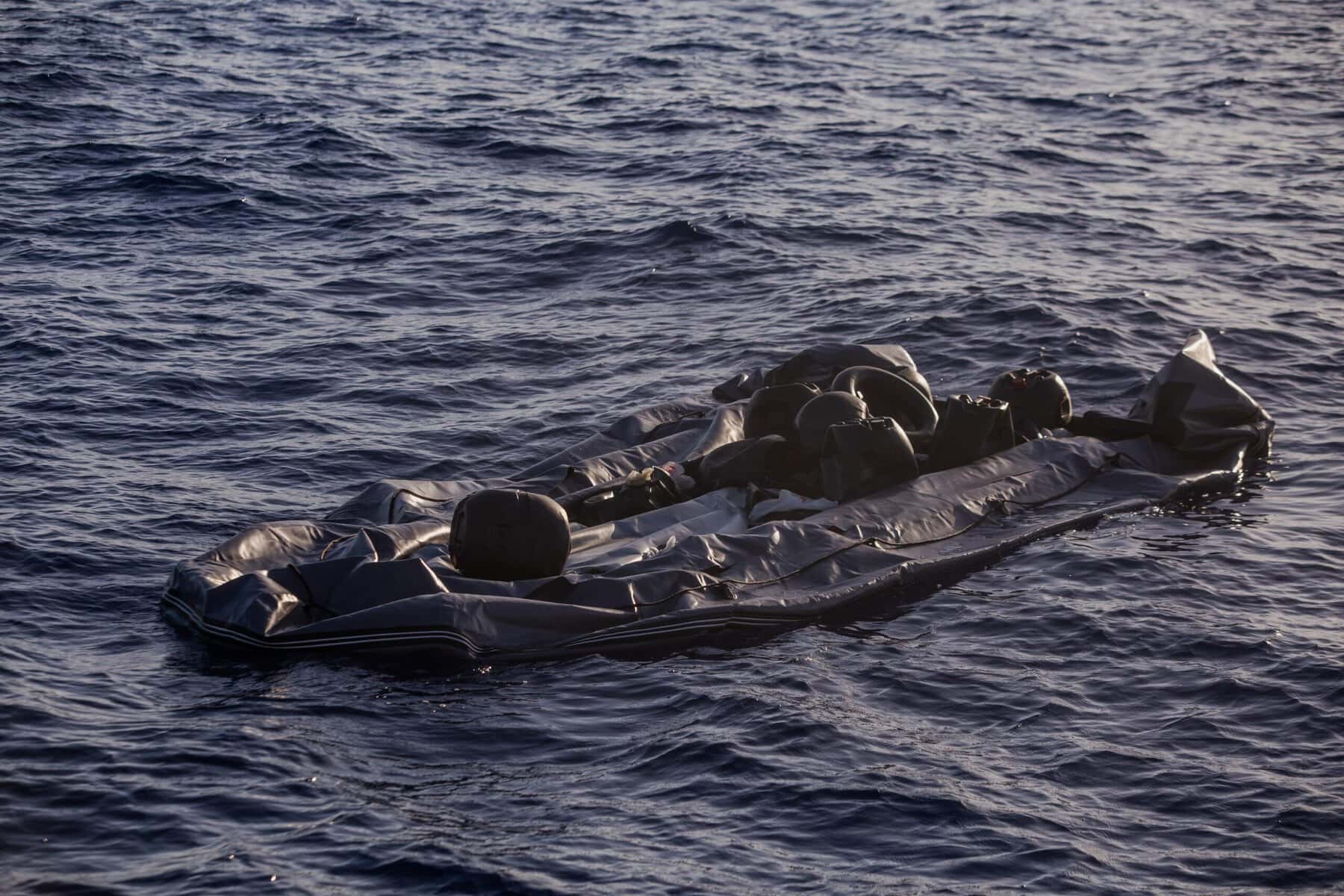
Against the silvery, granite-like surface of the sea, we finally caught a glimpse of the rubber boat amid the swells. Hope flared for a moment, only to fade instantly. The dinghy was deflated, shriveled, punctured, and stripped of its engine. We circled the empty wreck, its frame creaking against the waves as our search came to an end. Left drifting in international waters, the damaged boat remains a stark testament to the human cost enforced by European border policies.
The five survivors on our deck bear witness to these realities. All from Ethiopia, they met on the journey through Libya, where several had endured months of arbitrary detention. Now they are close friends. Fuad smiled and told me that being on board the NADIR meant things would finally improve. I deeply hope he is right, though experience of the European asylum system – marked by exploitation in agriculture, bureaucratic hostility, and discriminatory language in everyday life – leaves little room for illusions.
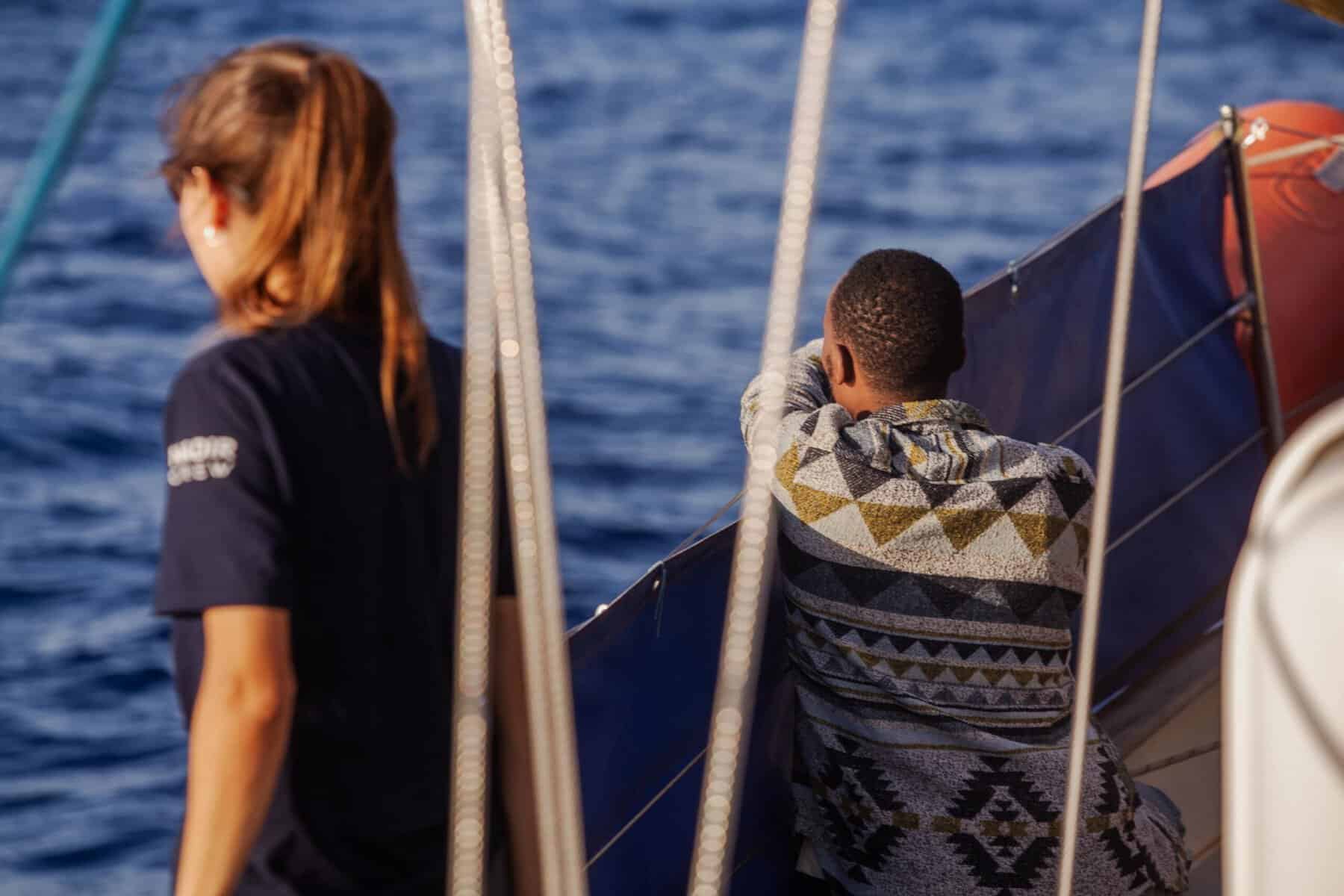
We shared dinner on the bow in quiet solidarity, looking out at the sea.
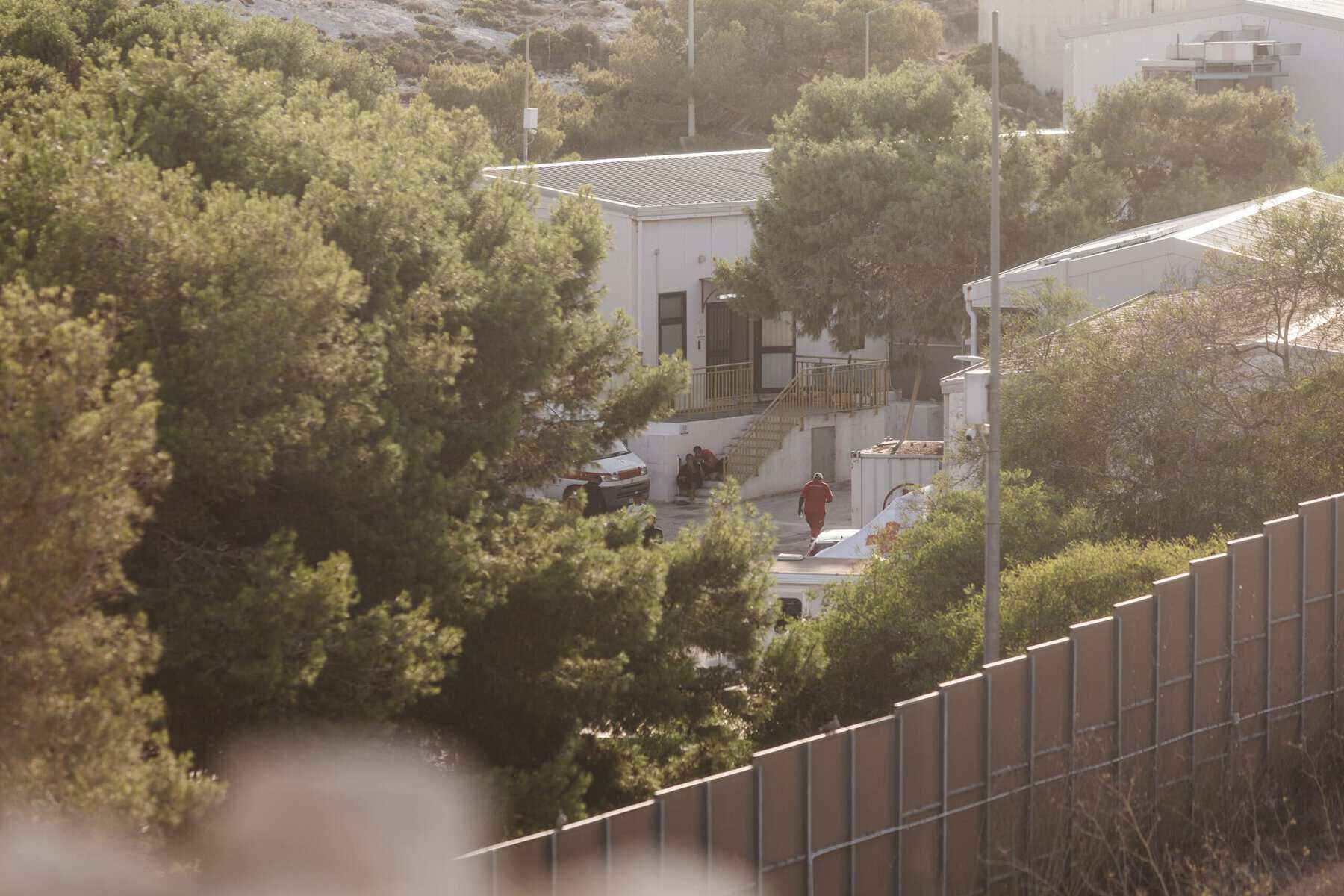
Dawn brought a reminder of how brief these encounters are. The northwestern promontory of Lampedusa appeared first, followed by the outline of the island. In the harbor, representatives from the Coast Guard, Frontex, and the Red Cross awaited us to initiate official procedures: cataloging, processing, and channeling people through the bureaucratic machinery. A few local solidarity groups were also present, handing out hot tea to offer a touch of warmth upon arrival.
The sea had held the five survivors for a brief moment in their journey; now the European border regime reclaims them, absorbing their lives into a system that leaves little space for individual dignity. Life and death at the EU’s borders consist of all these elements: the NADIR, the smiles of Fuad and his friends, and that leaky grey rubber boat left drifting on the open sea.
Who knows where its crew is now.
Operational report no. 8, 5–26 September 2026 – Nicola Cavallotti, crew member
Credits: Nicola Cavallotti | RESQSHIP